
Fr. Jean-Pierre Médaille
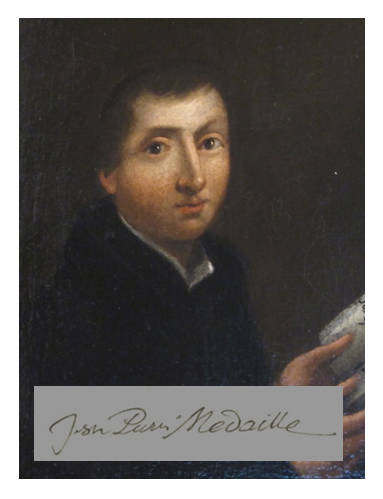
Jean-Pierre Médaille was born in Carcassonne, in the Southwest of France, on 6 October 1610. As a child, he learned from his father, who showed him the parish register recording his own birth and baptism alongside that of his younger brother Jean, that both boys were children of God an experience that shaped his early understanding of the faith. He received his education at the Jesuit College in Carcassonne, where he developed a concern for the poor and an admiration for Christ, reinforced by the example of St Francis de Sales. Having expressed to his father his wish to become a Jesuit, he entered the Jesuit novitiate at Toulouse in 1626, shortly before his sixteenth birthday, with his parents' consent.
During his novitiate, Médaille devoted himself to religious formation, prayer, and the imitation of the saints, and he developed a lasting devotion to Our Lady, St Joseph, St Stanislaus Kostka, St Ignatius, and St Francis Xavier. When plague broke out in Toulouse in 1628, his superiors moved the novices and unordained Jesuits to a farm at Lardenne for their safety; there Médaille met Francis Regis, whose prayer, courage, and acceptance of God's will left a strong impression on him. After the plague subsided, he returned to Toulouse to continue his studies, professing his first vows in 1628. After studying philosophy, he pursued theology and deepened his devotion to the Blessed Sacrament. He was then assigned to Aurillac, where he served as Minister, Prefect of Studies, and teacher of Latin, and where his work accompanying priests on missions and visiting the poor and sick gave him a clearer sense of their material and spiritual needs.
The Society of Jesus ordained Médaille a priest in 1637. During his tertianship at Montauban in 1642–1643, he devoted himself to prayer and reflection, through which his conception of what he called the "Little Design" matured; he came to understand it as founded on love of God and expressed through self-denial, so that its members might "live for Christ.
From 1643 to 1650, Médaille worked as a missioner attached to St Flour, travelling extensively and often on foot through Auvergne, Vivarais, and Velay. These missionary journeys, undertaken under difficult conditions, brought him into close contact with the poor and with numerous women—including single women and widows—who confided in him their desire to consecrate their lives to God and to serve those in need while remaining in the world. In response, Médaille began forming small groups of three to six such women, drawing on regulations and maxims he had prepared during his tertianship, to care for the sick and needy and to sustain the effects of the missions after his departure. Several such groups formed between 1644 and 1646, their members taking private vows, which Médaille took as a sign of divine encouragement for the Little Design. During this period, in prayer before the Blessed Sacrament, he also came to regard the Eucharist as the perfect model for the community, perceiving parallels between it and the life, vows, and love he envisioned for its members.
Médaille's work brought him into contact with Bishop Henri de Maupas of Le Puy, who administered the Saint-Joseph hospice for orphans and widows in that city and counted Saints Vincent de Paul and Francis de Sales—both founders of unenclosed congregations of women engaged in apostolic work—among his friends. The Bishop observed that the Little Design could not remain hidden while carrying out its charitable work, and, favouring an openly recognised congregation over secrecy, he supported its establishment with the agreement of Médaille's Provincial. Six young women, assisted by Marguerite de Montferrand, were prepared for the work, and in 1648 the Bishop approved a revised rule on an experimental basis.
On 15 October 1650, Bishop de Maupas received the vows of the six women in the chapel of the hospice, and each Sister signed the Act of Profession, witnessed by the Bishop and by Médaille. This act granted the community formal juridical status as a religious congregation under the patronage of St Joseph. On 18 October, Médaille was transferred to Aurillac to resume his mission work and serve as Minister, while Bishop de Maupas took charge of directing the Little Institute, assisted in his absence by Fr Lantages. The Bishop formally approved the Little Institute on 10 March 1651.
In the years that followed, Médaille continued to develop the Constitutions, incorporating experience and suggestions from the Bishop and Fr. Lantages, and he prepared additional spiritual writings, including the Maxims of Perfection and An Easy Devotion. He continued his missionary work at Aurillac and later at Montferrand, visiting the Sisters and observing the Congregation's growth in Velay. The Maxims were printed in 1657, and Médaille also produced the Little Directory and other writings such as the Elevations and Contemplations. Around 1660–1661, difficulties facing Bishop de Maupas in Le Puy led to his transfer to Évreux; before leaving, he helped finalise the Constitutions and confirmed his earlier approbation, which his successor subsequently reaffirmed by decree.
In 1662, conflict arising from the Jesuits' forced transfer of their Montferrand college to Clermont drew Médaille away from missionary work for about a year to help negotiate a settlement and establish the college at Clermont-Ferrand; he resumed his missionary duties once the matter was resolved. The demands of constant travel gradually affected his health. He nonetheless completed the Little Directory for the Sisters, sending it to Le Puy with the request that every house keep a copy, and he continued to correspond with the Sisters, regarding himself not as a legislator but as God's instrument in their foundation.
Following a severe winter and an unusually hot summer, declining health led to Médaille's transfer to the Jesuit college of Billom in 1668–1669, where he continued to write, particularly the Elevations and Contemplations, intended to complement the Maxims. His health did not improve, and he died there, resigned to God's will, on 30 December 1669, at the age of fifty-nine. Confidential reports sent by his superiors to Rome describe him as a man of great spiritual worth, gifted in education, in holding office within the Society, and in teaching and preaching. The eulogy delivered after his death affirmed that he had spent a great part of his life in the missions of the province of Toulouse, where his reputation for zeal and holiness earned him the title "the Saint" or "the Apostle."